
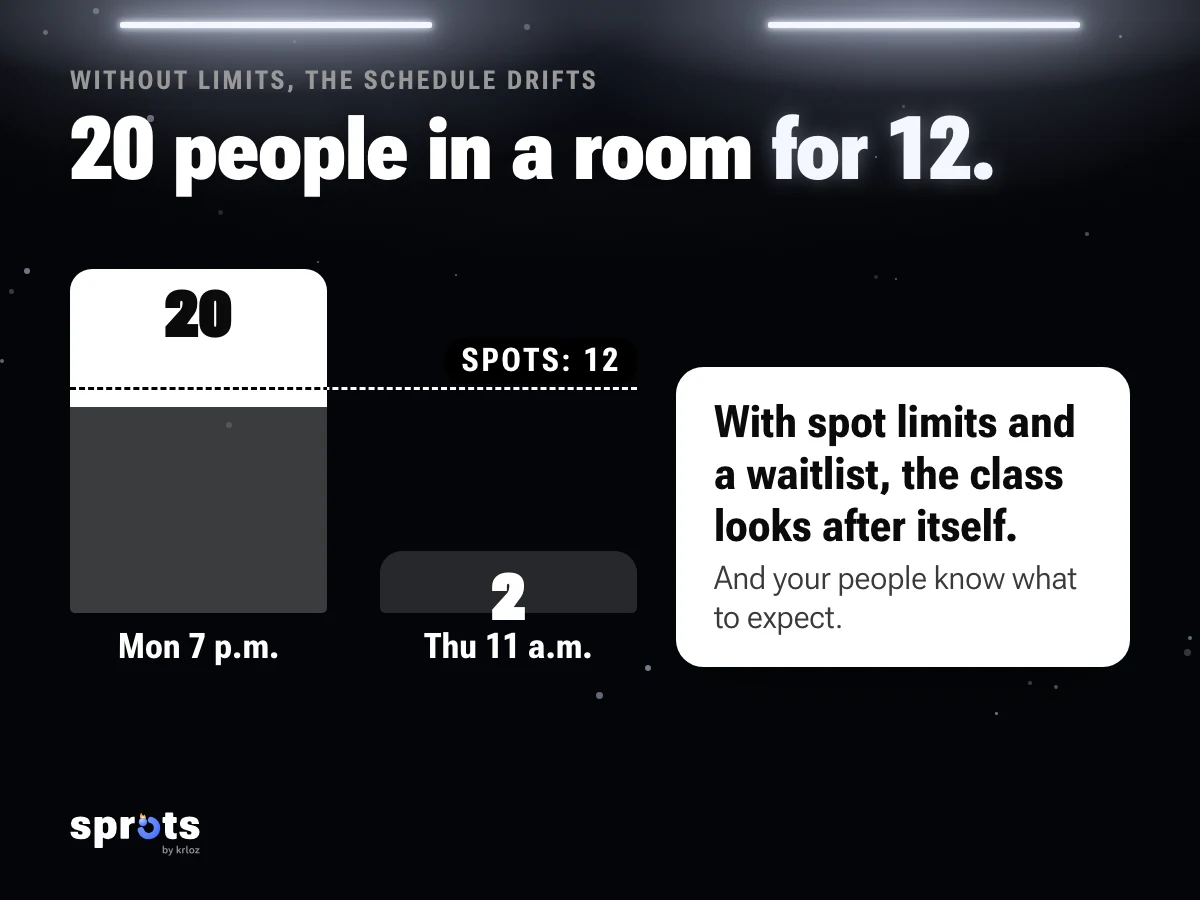
Without spot limits, a schedule drifts out of balance on its own: Monday at 7 p.m. you have twenty people in a room built for twelve, and Thursday at 11 a.m. you have two. With a limit on spots and a waitlist, the class looks after itself, and your people know what to expect.
It works the same for a gym running ten classes a day and for a coach with two groups a week at the park. The numbers change, the method doesn't.
Start by watching for two weeks.
Before you change anything, write down how many people come to each class for two weeks. A notebook is enough: day, time, headcount. You'll see which classes fill up, which stay empty and at what time of day the mood of the week shifts.
Build the schedule around what actually happens, not what you assumed was happening.
A limit with a reason.
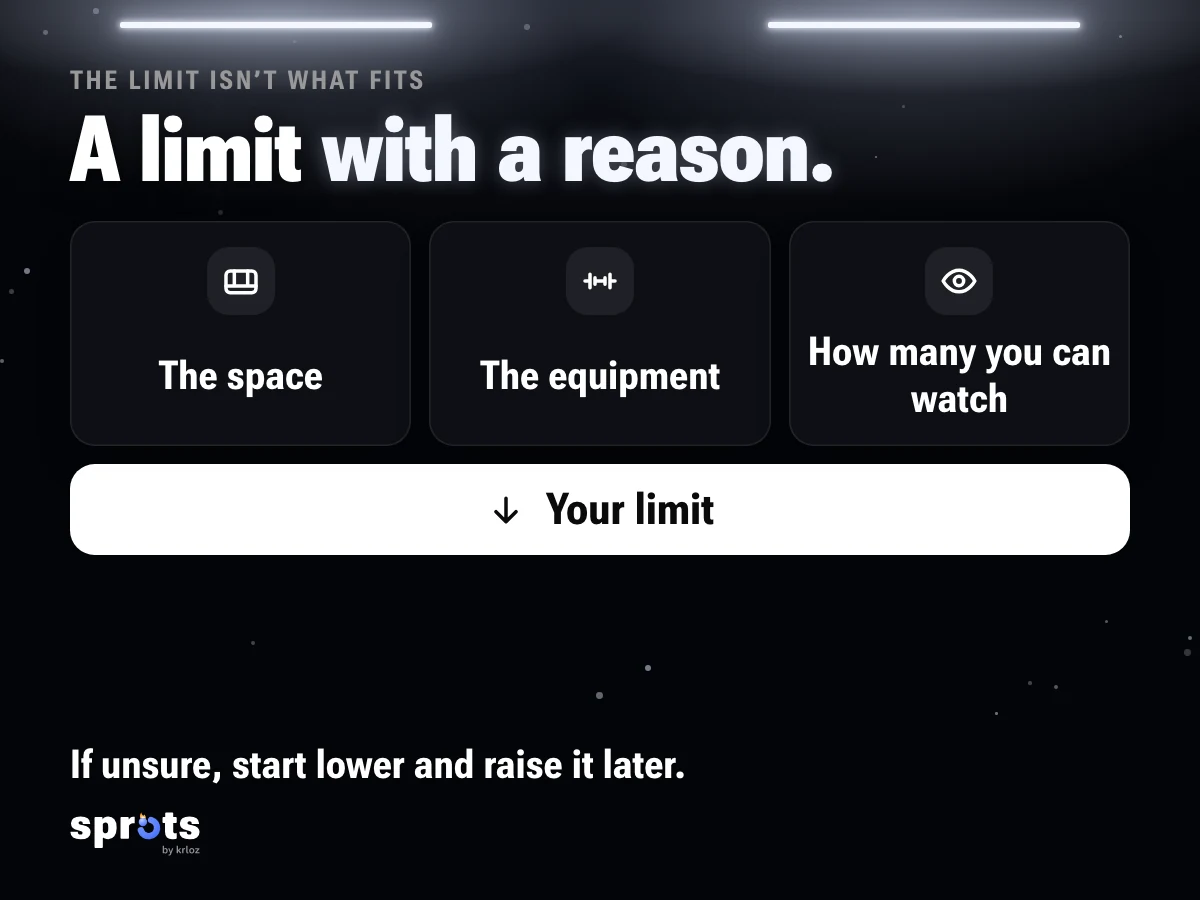
The limit isn't the most people who can physically fit in the room. It's the number that lets you give each person real attention and lets everyone train without bumping into each other. Think about three things: the space, the equipment (how many barbells, how many mats) and how many people you can keep an eye on at once.
If you're unsure, start lower and raise it if there's room to spare. Raising a limit is easy; lowering it upsets the people who already booked.
Booking and cancelling, with rules.
Three rules, written down and visible to everyone:
- How late people can book. For example, up to one hour before class.
- How late they can cancel without consequences. Pick a cutoff that gives you time to offer the spot to someone else: a few hours ahead, not a few minutes.
- What happens if someone books and doesn't show up. It can be nothing the first time and a warning after that. If your plan is a number of classes per month, decide whether a no-show uses up a class.
What matters isn't how strict the rule is. It's that it's the same for everyone and that people hear it before it applies, not after.
The waitlist, step by step.
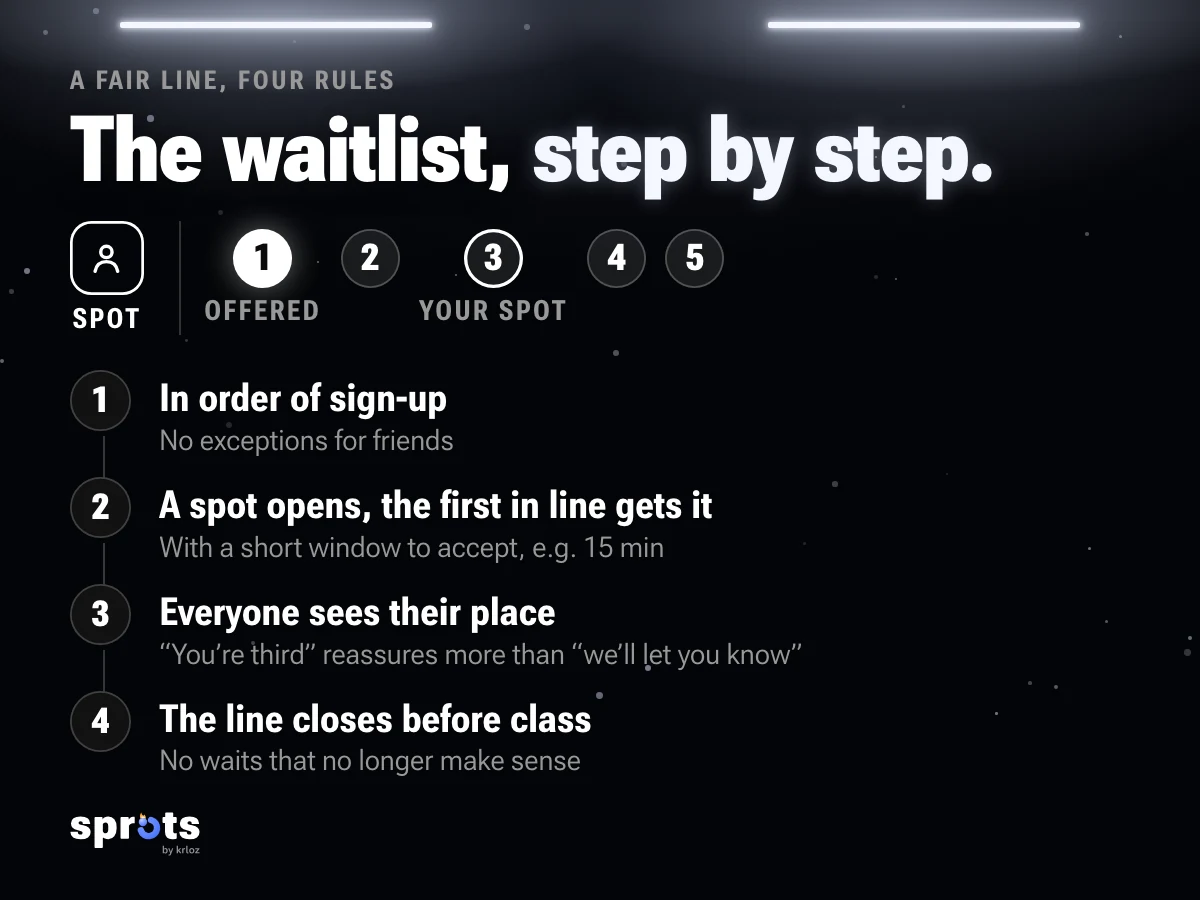
A fair waitlist has four rules:
- It's in order of sign-up. Whoever joined first goes first. No exceptions for friends.
- When a spot opens, it's offered to the first person in line, who gets a short window to accept, say 15 minutes, less if class is about to start. If they don't answer, it moves to the next person.
- Everyone can see their place. "You're third in line" reassures more than "we'll let you know."
- The line closes before class. A little before it starts, nobody else joins: that avoids waits that no longer make sense.
If you run it by hand on a group chat, the hardest part is rule 2: someone has to be watching the phone at the moment a spot opens. That's where software helps most.
When a class is always full.
A long waitlist is information, not a problem: it tells you people want to come at that hour. If the same class has a line three weeks in a row, think about opening a second one at that time in another space, or an hour earlier or later, instead of raising the limit.
And ask the people on the waitlist whether another time would work for them. They'll tell you more than any spreadsheet.
When almost nobody shows up.
Two or three empty classes aren't a failure. First check whether the time slot is the problem: does it fall on a holiday or at the end of the month? Is another class pulling people away? Then you have three options: merge it with another class, move it or close it.
If you close it, give notice, and tell each person who had booked, not at the last minute. A class cancelled when it's already time to start costs more trust than a small class does.
The days that shift your week.
Holidays, school breaks and summer all move your week. Decide ahead of time which classes run on those days and post it a week in advance. The day you improvise, someone arrives at a locked door.
If you coach on your own.
A coach with a group of eight at the park needs the same things as a gym with a hundred members: a limit with a reason, rules for booking and cancelling, a fair line and timely notices. If you train people at home, in a studio or online, it's no different. What changes is the length of the list, not what you have to decide.
And Sprots.
Sprots brings your people, their plans, your schedule and their payments into one place, and the people who train with you use the same app. It's for coaches and for gyms. Coming soon to the App Store and Google Play. Tell me when it launches →