
Chasing a payment is one of the most uncomfortable parts of running a training business. You'd rather be on the floor, and the other person feels watched. It's rarely bad faith: they forgot, they weren't sure what day it was due, or they couldn't find how to pay.
That can be fixed, and the fix is organization, not persistence. Here are the pieces, in the order that makes sense to build them, whether you run a gym with hundreds of members or a coaching practice with twelve clients.
One price, one date.
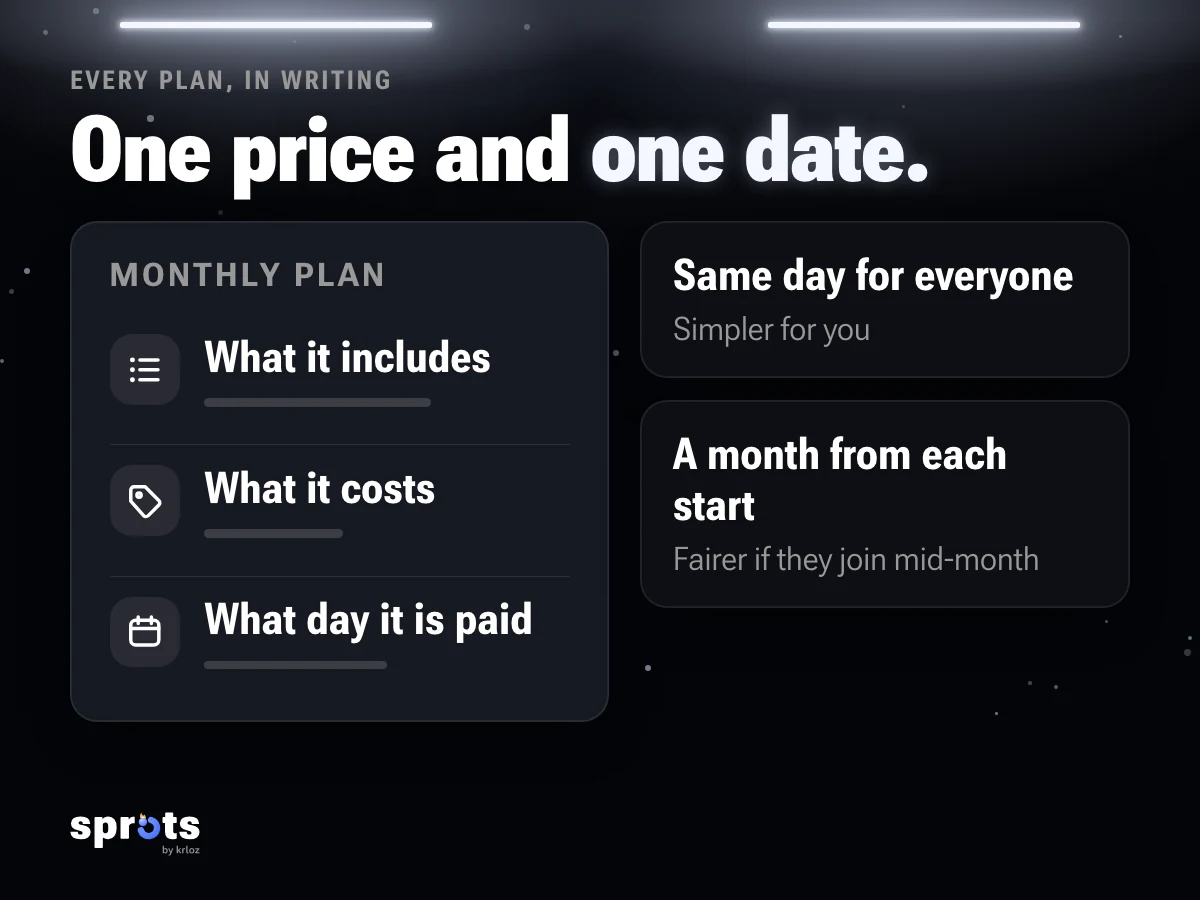
Every plan should say three things, in writing: what it includes, what it costs and what day it's paid. If it lives only in your head, every person understands it their own way.
There are two ways to set the date. One: the same day of the month for everyone, which is simpler for you. Two: a month counted from when each person started, which is fairer to someone who joins mid-month. Pick one and don't change it every month.
Make paying easy.
Every extra step is an excuse to do it tomorrow. The ideal is a payment link, or bank transfer details, always in the same place, that people can find on their own without messaging you to ask.
If someone prefers to pay in cash, don't forbid it: write it down that same day, with the name and the amount. A payment that wasn't recorded ends in an awkward conversation, and that's exactly the one you were trying to avoid.
Fewer times to collect.
If your people are open to it, offer to pay for several months at once, a quarter or six months, sometimes with a small discount. You collect fewer times a year, and every charge that doesn't exist is one you can't forget or chase. It isn't for everyone: someone just starting often wants to try one month first. Offer it as an option, not a requirement.
Remind before, not after.
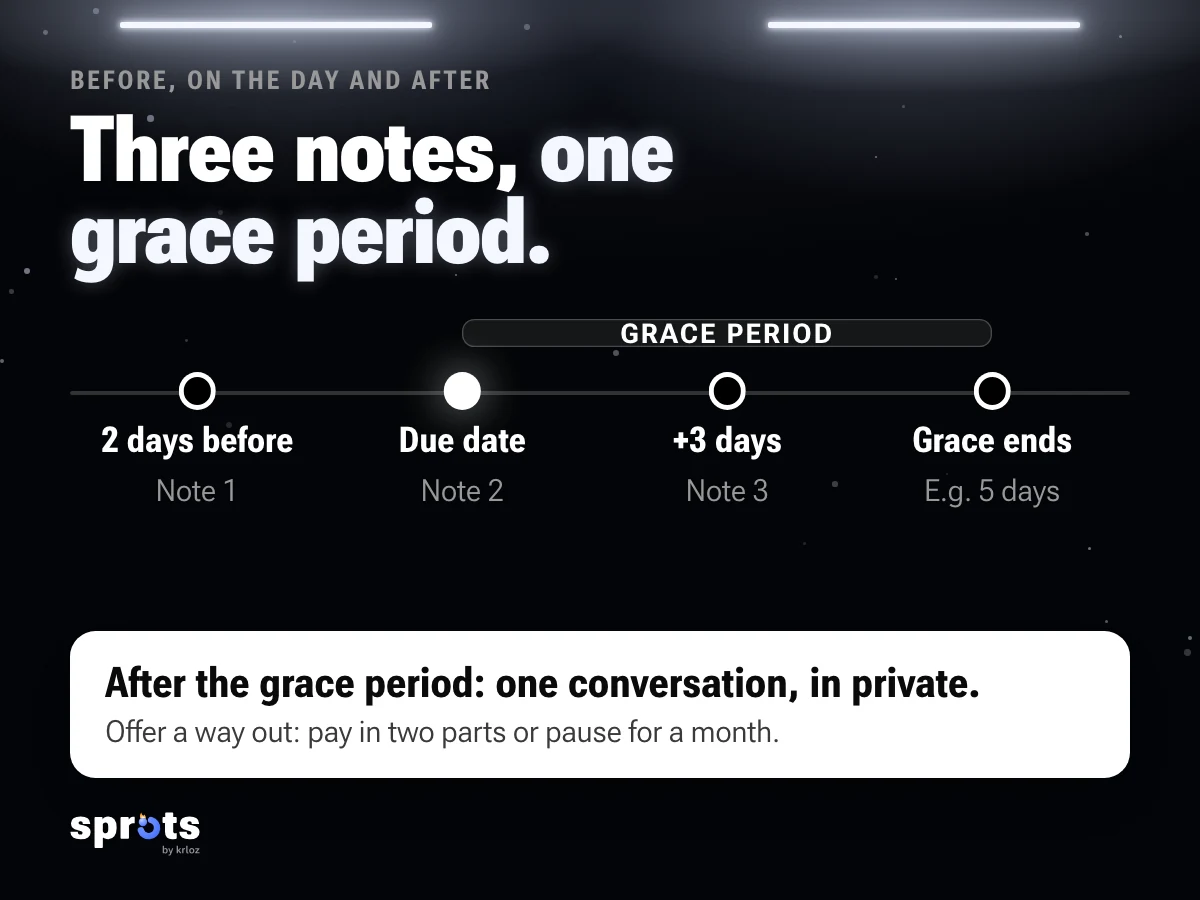
Many late payments are simply forgotten ones, and a friendly note before the due date takes care of them. Three messages, at three moments. The names and amounts are examples; swap in your own.
Two days before. "Hi Camila, your October plan is due on the 5th. Here's the link in case you'd like to pay early: [link]. Let me know if you have any questions."
On the due date. "Hi Camila, your plan is due today. Here's the link: [link]. Thank you."
Three days after. "Hi Camila, were you able to look at the plan payment? If something came up or you need a different date, tell me and we'll sort it out."
Notice what they don't do: they don't blame, they don't threaten and they don't add anything the person doesn't already know. They all carry the link, and they sound the same for everyone.
A grace period, in writing.
Decide ahead of time how many days late you'll tolerate before acting, five for example, and what happens next: can they keep booking classes? Is the plan paused?
If you don't decide in advance, you decide one person at a time, looking them in the eye, and you end up flexible with some and strict with others. A rule that's the same for everyone takes the weight off you: it isn't you, it's the rule.
One conversation per late payment.
Once the grace period is over, write once, in private, never in the group chat. Start by asking how they're doing and offer a way out: paying in two parts, or pausing the plan for a month. A client who pauses is still your client. One who got billed angrily often doesn't come back.
Keep what you collect separate from what you talk about. Don't mix "how did the sessions go?" with "you owe me for the month": the person ends up wondering if you're asking out of interest or out of money. If they don't answer, wait a week and write a second time. That's enough.
Keep it all in one place.
To stop chasing, you need to see at a glance who has paid, who is due this week and who is late. A spreadsheet is enough: name, plan, due date and status. There's one rule: update it the day the payment arrives.
The day it becomes hard to keep up, you know you need help. And for anything about invoices and taxes, check with your accountant: organizing your billing doesn't replace that conversation.
The short list.
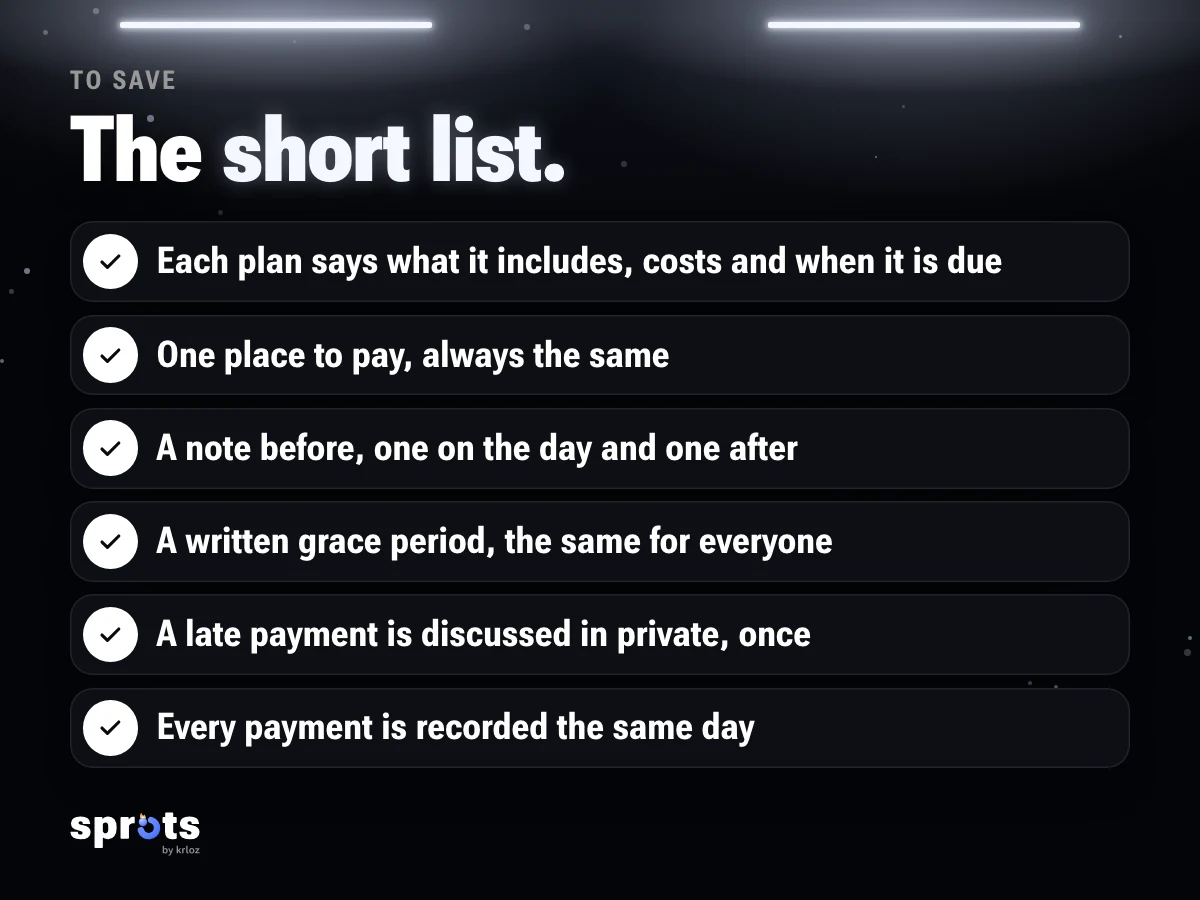
- Each plan says what it includes, what it costs and what day it's due.
- There's one place to pay, always the same.
- You send a note before the date, another on the day and another after.
- You have a written grace period, the same for everyone.
- You talk about a late payment in private, once, offering a way out.
- You record every payment the same day.
And Sprots.
Sprots brings your people's plans, their payments and who still owes into one place, so you don't carry it in your head or in a spreadsheet. It's for coaches and for gyms. Coming soon to the App Store and Google Play. Tell me when it launches →